







From our series:
The Signal Room

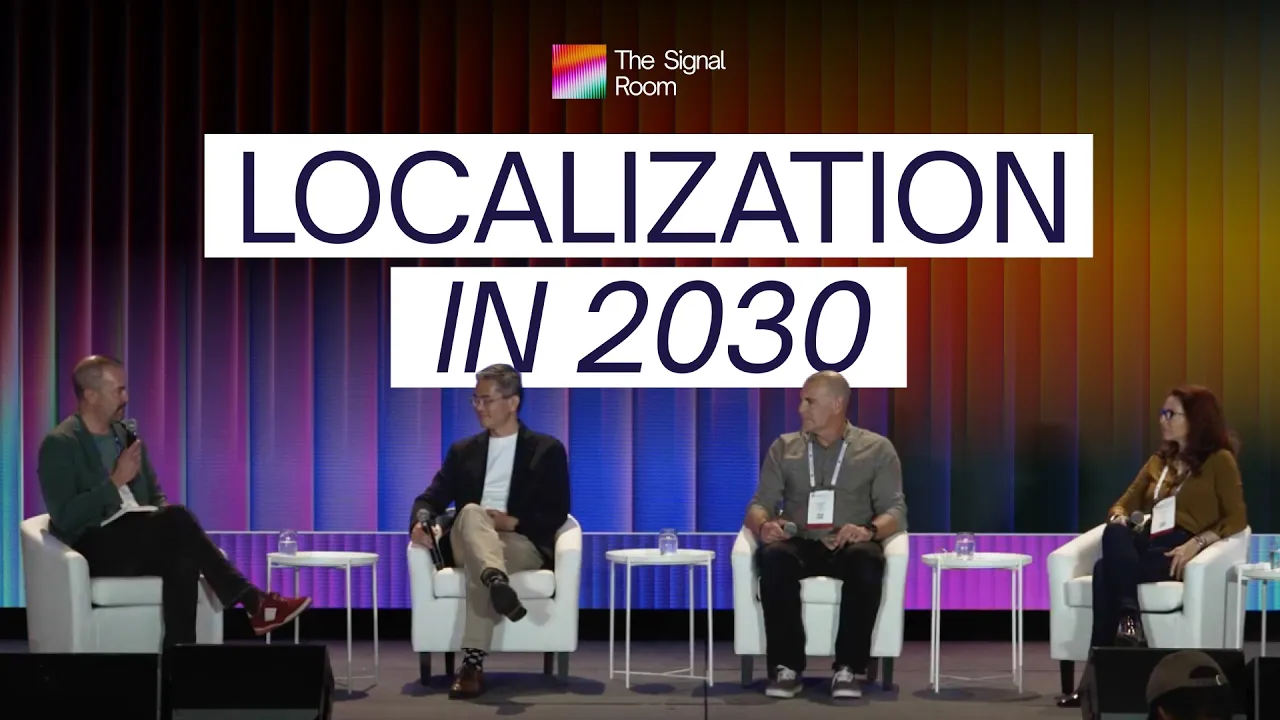
Multilingual AI changes how global content is created. So the localization industry faces hard questions about its own future. Will localization still be a separate workflow? Does a source text still matter? And what role will humans play once AI produces language at scale? In this live episode of The Signal Room Podcast, recorded at LocWorld56 Vancouver, Jonas Ryberg and Wada’a Fahel are joined by Joaquín Muñoz of Life360 and Chuen Hong Lew of Centific.
The conversation opens with three signals. Wada’a explains why cutting local market teams is riskier than it looks. Joaquín asks what Salesforce’s acquisition of Braze means for workflows built on third-party platforms. Chuen Hong argues that most of the world cares less about saving time than about how it spends time.
After a quickfire round, the panel turns to the main question: will localization still be a separate workflow? Wada’a argues the industry has outgrown the term and should focus on engineering relevance. Joaquín describes design, development, and internationalization happening together from the first brief. Chuen Hong calls it a move from source to translate to intent to create.
What You’ll Learn:
Why cutting local market teams can cost more than the savings that show up on paper
How platform acquisitions like Salesforce buying Braze put localization workflows at risk
Why the panel thinks English matters less in the age of AI
How the source may shift from text to the brand, the intent, and the desired experience
Why culture, humor, and taste are still hard for AI to get right
How human roles will change, from heavy lifting to gatekeeping, curation, and AI governance
Who should own localization, and why it needs a direct line to the C-suite
Wada'a Fahel is a localization and content technology strategist with over two decades of experience leading global content operations for major brands, including Harley-Davidson, Zendesk, and Xerox. She is the founder of LocVerse Consulting, where she helps startups and global enterprises reimagine localization as a strategic business enabler rather than a support function.
Jonas Ryberg is an executive leader with extensive experience in building organizations, teams, and platforms, driven by a strong customer-centric mindset. His expertise spans international communication, branding, client relations, and organizational leadership. Jonas is currently the Senior Vice President of Multilingual AI at Centific.
Joaquín Muñoz is Head of Localization at Life360 and has worked in localization for almost 30 years. At Life360, he built a design-driven localization ecosystem that runs from Figma straight into Braze. He has seen offshoring waves come and go, and he believes the more creative and transcreational the content, the more human judgment it needs.
Chuen Hong Lew became CEO of Centific in August 2026 and is a Fellow at the Stanford Institute for Human-Centered AI (HAI). He was previously a partner in venture capital, investing in frontier technology, and is a neuroscientist by training. Chuen focuses on making AI “global yet local,” with an emphasis on context, judgment, and taste.
More episodes



Get a personalized demo
You are not short of AI. You are short of certainty.
Move forward with AI you can govern. Flow gives you the control to put intelligence to work across your enterprise, with decisions tracked, traced, and attributable
Harnessed intelligence. Context first. Trust by design.